What Is LS Diet?
Published · Updated
LS Diet is low-starch, low-sugar eating that keeps insulin low enough for your body to burn stored fat. It is not a crash diet, not a meal plan, and not a calorie-counting system. It is an eating approach built around one mechanism: when insulin stays low, fat burning turns on.
Most diets focus on how fast you can lose weight. LS Diet focuses on how you can eat for the rest of your life without gaining it back. The difference sounds small. It is not.
How LS Diet Works
Every time you eat starch or sugar, your body converts it to glucose. Your pancreas responds by releasing insulin. Insulin's job is to move that glucose into your cells for energy. The problem is that high insulin also signals your body to store fat — and blocks it from burning any.
Think of it this way: fat is always there, like the sun in the sky. Insulin is the cloud cover. When insulin is high, dark clouds block the sun. Your body cannot access its own fat stores. When insulin drops, the sky clears, and fat burning resumes.
LS Diet lowers insulin by targeting the two biggest glucose drivers in the average diet: starch and sugar. Three levers make this happen:
- Eat less often — fewer meals and snacks means fewer insulin spikes across the day
- Eat smaller portions — less food means a smaller glucose load per meal
- Eat different foods — replacing high-starch and high-sugar foods with lower-insulin alternatives
The third lever is the one you can start today without changing anything else. It is also the most effective long-term, which is why it is what LS Diet is named for.
What You Eat on LS Diet
LS Diet is not an elimination diet. It is a reduction diet. You are not cutting out entire food groups. You are reducing the foods that drive insulin the most and building meals around the foods that do not.
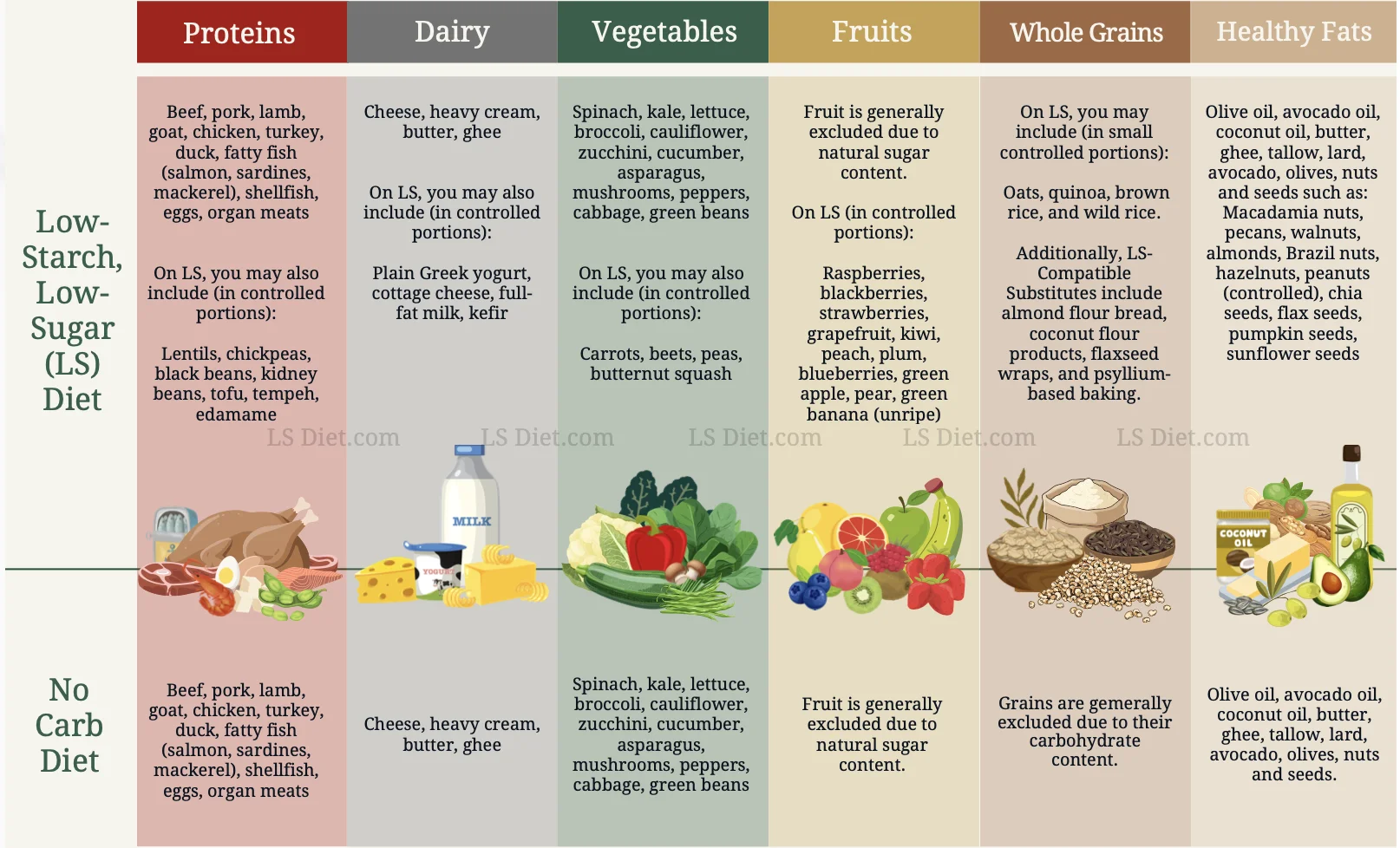
The practical breakdown looks like this:
Always eat
- Proteins: beef, pork, lamb, chicken, turkey, fish, eggs, organ meats
- Non-starchy vegetables: spinach, kale, lettuce, broccoli, cauliflower, zucchini, mushrooms, peppers, cabbage, green beans
- Healthy fats: olive oil, avocado oil, coconut oil, butter, ghee, nuts and seeds
Eat in controlled portions
- Low-sugar fruits: raspberries, blackberries, strawberries, green apple, peach, plum, green banana
- Legumes: lentils, chickpeas, black beans, kidney beans, tofu, tempeh, edamame
- Some dairy: plain Greek yogurt, cottage cheese, full-fat milk, kefir
Reduce significantly
- White rice, bread, noodles, pasta, cereal, pastries, crackers
- Sweetened drinks, juice, soda, energy drinks
- Candy, chocolate bars, desserts, packaged snacks
Occasional and intentional
- Small controlled portions of oats, quinoa, brown rice, wild rice
- LS-compatible substitutes: almond flour bread, flaxseed wraps, psyllium-based baking
The goal is not a clean streak. The goal is a sustainable reduction in your overall insulin load across the week. A meal with rice is not a failure. A pattern of high-starch eating every day is the problem.
Why LS Diet Is Not Keto
Keto (No Carb) and LS Diet work on the same mechanism: lower insulin by reducing carbohydrates. The difference is how far they go and who can actually sustain them.
| LS Diet | Keto | Standard Diet | |
|---|---|---|---|
| Carb restriction | Reduce starch + sugar | Strict (<20–50 g/day) | None |
| Fruit allowed | Yes (low-sugar varieties) | No | Yes |
| Grains allowed | In controlled portions | No | Yes |
| Mechanism | Lowers insulin | Ketosis | No specific mechanism |
| Social flexibility | High | Low | High |
| Weight permanence focus | Yes — WPT built in | No | No |
Keto eliminates fruit, most dairy, all grains, and most legumes. That works metabolically. But it also means that virtually every shared meal — a family dinner, a work lunch, a holiday gathering — requires a public explanation. For many people, especially those who grew up in food cultures where rice, noodles, or bread are the daily default, this creates a social identity conflict that eventually wins.
LS Diet does not ask you to announce yourself at every meal. You eat the protein, the vegetables, the healthy fats. You take a smaller portion of the starch, or skip it when you can. You make the better choice without making it a production.
LS is not restrictive eating. It is selective eating. The difference is psychological.
Speed is also not the priority. Losing 100 pounds in three months often means muscle loss and a metabolism that is slower than when you started. Unless you are managing a specific medical condition, sustainability matters more than speed. LS is built for the long run, not the sprint.
Why LS Diet Exists
Oscar Poon lost more than 80 pounds. Three times. Each time, the weight came back.
The first time, he went vegetarian. It worked. But every meal felt like a punishment, and the restriction eventually wore him down. The second time, he tracked calories and drank vegetable smoothies for months. He lost the weight. He was also hungry almost every day. He had willpower. He did not have peace.
The third time, he went No Carb. He lost the weight again. But as an Asian Canadian surrounded by family and friends for whom rice and noodles are a daily ritual, every shared meal became a negotiation. Every gathering came with a side of explanation. The approach that worked metabolically was quietly destroying his social life.
LS Diet was built as the fourth attempt — the one that does not require choosing between your health and your culture. Using LS Diet, Oscar went from 310 lbs to 190 lbs, reaching that weight around November 2024. He hiked three peaks. He ran his first 10K. He has not regained the weight.
Most people do not fail to lose weight. They fail to maintain it.
The Behavioural Layer
LS Diet handles the food. Weight Permanence Training™ handles the habits and psychology that make it stick long-term. They work together but they are not the same thing. If you want to understand why the weight keeps coming back even when you know what to eat, start with the 5 Awareness Stages.
Related Posts
Busy Professional Execution
How to Lose Weight With a Desk Job
Most office environments are designed around convenience eating, inactivity, and stress. Sustainable weight loss requires structure, meal planning, and behavioural consistency.
Busy Professional Execution
Can You Lose Weight Without Going to the Gym?
You do not need a gym membership to lose weight. Sustainable food systems and behavioural consistency matter more than intense exercise routines.
Low Starch, Low Sugar Science
Is Diet or Exercise More Important for Weight Loss?
Most weight loss results come from sustainable food systems, not extreme exercise routines.
Low Starch, Low Sugar Science
Do You Need to Count Calories to Lose Weight?
Calorie counting may help some goals, but many people can lose weight sustainably without tracking every number.
Low Starch, Low Sugar Science
How Much Does Weight Loss Affect Your Metabolism?
Weight loss becomes increasingly different with age as metabolism, recovery, and energy levels gradually change.
Low Starch, Low Sugar Science
How Much Weight Can You Realistically Lose in a Month?
Most sustainable weight loss happens more gradually than extreme diet marketing suggests.
Start the free LS Diet training.
Awareness Training + Action Practice. No credit card.